Calm at the Fire, Overwhelmed by the To-Do List
Chris Binch can climb onto a fire engine at two in the morning, gather what he needs on the way, walk into a fully developed house fire and stay completely calm. He also cannot get through a list of ordinary tasks without it keeping him awake.
He said both things inside ten minutes of each other, and if you run a business you probably recognised yourself before you finished the sentence.
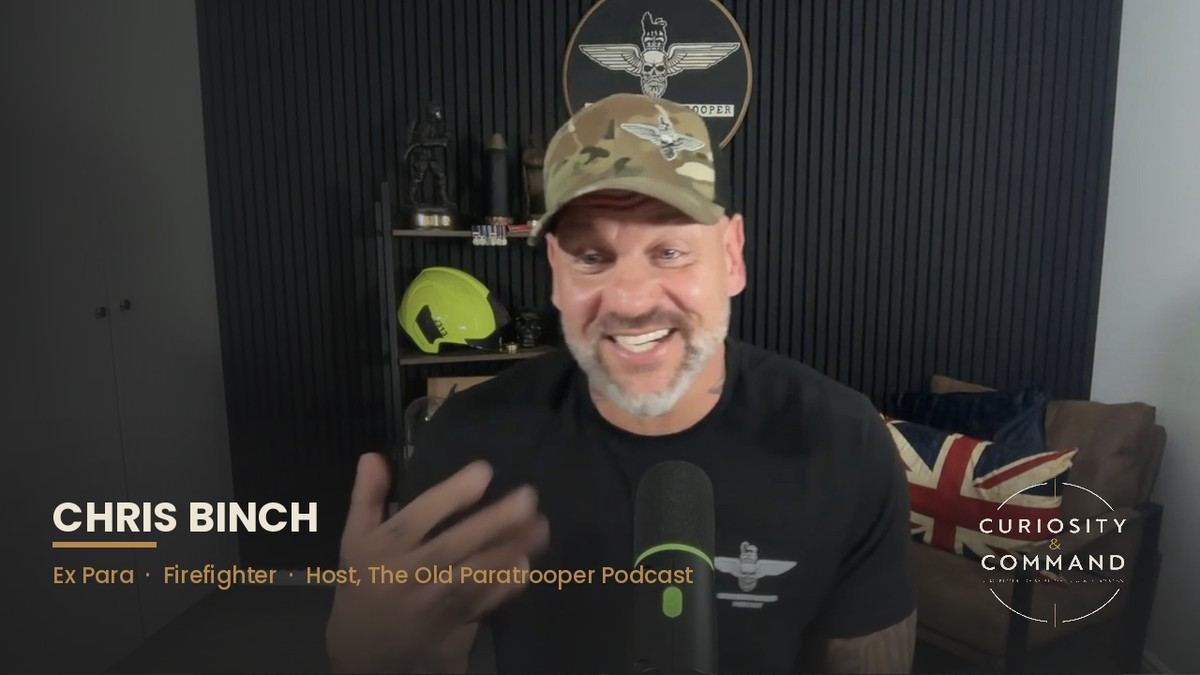
Chris served in the Parachute Regiment, worked close protection in Iraq, spent three years protecting ships from piracy and then twelve years in the fire service. He hosts The Old Paratrooper Podcast. When we spoke he was days from flying to Albania to walk a 50K mountain ultramarathon with a bad hip and, by his own account, no training. He had said yes anyway.
What he told us adds up to a short course on leading yourself. Here it is, in his words wherever we can manage it.
Calm is trained. Chaos is what gets left untrained.
Ask Chris what happens when the call comes in and he walks you through a process. "From the minute that turnout comes in, pips go down, you're on the truck. I'm calculating what I need to do next. I've got a procedure, I know what I'm doing. I'm calm."
Firefighters build their own systems. Where the gloves hang. What goes on first. What to find out on the way. "That's why training's so important, coupled with experience."
Then the other half. "Day to day stuff sometimes overwhelms me. I've got loads of tasks to do, and I can't process it. It keeps me awake because I'm like, I need to do this, I need to do this, but I can't organise it."
Nobody drills the admin. That is the whole explanation. If you are brilliant in the emergency and sunk by the quiet work, you built a process for one and never built one for the other. On our Lead With Ownership course we teach Prioritise and Execute: when everything is shouting, pick the one thing, do it, pick the next. It works on a fireground. It works on a Tuesday. The only difference is that nobody makes you rehearse it for the Tuesday.
Avoidance sends a bill, and then it sends the decision back.
We asked Chris whether the anxious inner voice had ever won. Once. He was on leave from a security contract in Iraq, the kind of contract that leads to better ones. "As leave goes on, the last few days you start to get that feeling that you're going back, that anxiety feeling. It got to a point and I let it work me up that much that I didn't go back. I quit the job and I regretted it. I massively regretted it."
Then the part every owner should sit with. "I ended up a few months down the line getting a job with a different company and going back out anyway. All I did was just sort of extend that period of leave and talk myself out of it."
That is the exact shape of avoidance in a business. The conversation with the underperformer does not disappear because you put it off. The price rise you have been about to do since spring still has to happen. The manager you need so the business stops running through you is still not hired. Chris paid with a contract he wanted and a few months of drift. He looks back on it now as the right call, and he still had to make the same decision twice. Owners pay in margin, in people who leave, and in years.
Courage is acting with the fear still there.
"People that watch this think I'm the most confident person in the world. I get anxiety more than most before I do episodes, before I do any event. I've got anxiety about flying out to Albania on Wednesday, to the point it's crippling."
He boxed for twelve years. Fight day was "50-50 whether I'd turn up for the fight. I've never not turned up, but you'd be close to going." His reason for going anyway is plain. "You never grow. If you walked away from every experience that made you feel uncomfortable, I'd have never done anything."
What has changed over the years is recognition. "I know how my body reacts now. I just go, yeah, here we go again. This is how I feel before I do anything." The fear is a known quantity, so it stops being a decision. Owners spend a lot of energy waiting to feel ready before the hard call, the big pitch, the sacking. Chris's evidence says the readiness never comes, so you go anyway.
The signal is quieter than the noise.
Because he feels anxiety before almost everything, Chris has had a lifetime of practice separating the useful warning from the noise. His rule is simple. The one that matters shows up as clarity in his head. The noise shows up in his body. "I get a feeling in here that it's not right, rather than a physical manifestation. I look at it from a different perspective, through calculating as well."
You will rarely get certainty. What you can build is a record of which signals have earned your trust.
Turn up again. Then again.
Chris went through P Company, the Parachute Regiment's selection, three times in six months before he passed. "I wanted that maroon beret, nothing was gonna stop me. I even was questioned by the officers going, are you sure this is for you?" He applied to the fire service three times over ten years. The podcast gets the same treatment. "It doesn't matter what happens, I will make this work." He was sold on it, and the officers questioning him did not change that.
He was equally honest about the flip side. The only thing that will stop him is "me, through my own kind of getting bored." Naming your own failure mode out loud, in public, is a leadership act, and most owners never do it.
Manage yourself before there is a problem.
Chris compared the British and American approach to mental health. "Going to therapy over there is like going for a walk or going for a pint with your mate. They will pay for a therapy session before there is a problem." Then this: "We have this habit of waiting till it becomes a major issue before we try and resolve it. If you manage it before it reaches there, it may never get to that point."
He knows his own levers and pulls them early: food, alcohol, exercise, time behind a laptop. After a heavy bank holiday weekend he cuts the drinking for a few weeks, walks in the forest by his house, gets to the gym two miles down the road. None of it is dramatic. That is the point. On Lead With Ownership we call this Discipline Equals Freedom: the owner who protects sleep, movement and one honest conversation a week never needs the heroic recovery, because there is nothing to recover from.
Own the mistakes. They are the material.
"I would not be anywhere or done half the things I'd done if I hadn't made the mistakes. I have failed that many times at different things that people probably won't believe it. Those failings and those experiences are what shaped me."
His one regret from the army is time wasted. "Do more when you're in, because you think it's gonna last forever. I'd have done a lot more courses. I kind of squandered it a little bit." He names the drinking culture and the garrison town, and he still lands the verdict on himself. That is Extreme Ownership as we teach it on Lead With Ownership, without him ever using the label, and it is why he can talk about it at all.
An owner who can say "I made a bad decision there and now I've got to live with it" in front of the team gets a team that reports problems early, and an owner who cannot say it teaches the team to hide.
Character before validation.
Chris has had the trolls and the old acquaintances who reappear when something goes well. "I know I'm a good person. I don't need to prove it. I know what my morals and my ethics are." His description of criticism: "That's a reflection of other people's characters, not my own."
Check the Ego, another Lead With Ownership principle, cuts both ways. The ego that needs applause and the ego that cannot take a hit are the same ego. Settle what you stand for, take hard feedback from the few people whose judgement you respect, and let the rest go past.
One thing to do this week.
Write down the decision you have been delaying. Put a date on it inside seven days. Tell one person the date. That is the Iraq contract, brought forward instead of paid for twice.
If the decision you are avoiding is about your own role in the business, take the Bottleneck Review at https://leadwithownership.kaizen-summit.com/. Ten minutes, free, and it shows you where you are the constraint.
The full conversation with Chris is on the Curiosity & Command podcast from Friday 11 September. Have a listen: https://open.spotify.com/show/5gy3hTdI2yv05nJxoF70bz
If anything here is close to home, Samaritans are on 116 123, free, any hour. Veterans and their families can also contact NHS Op COURAGE.
